

ARGUABLY, THE BAY Area’s biggest traffic jams caused by the upcoming FIFA World Cup took place over three days in May. K-pop megastars BTS performed three concerts at Stanford Stadium. 150,000 “BTS Army” members had to wend their way to the campus of Stanford University, which is set in a bucolic hillside in Palo Alto far from major freeways and a full mile from the city’s commuter rail station.
Typically, an event of that magnitude would take place at Levi’s Stadium in Santa Clara, but World Cup regulations forbid major events from taking place at a World Cup venue during its “exclusivity period.”
When Qatar and Switzerland kick off June 13 at Levi’s Stadium, regional officials expect few such traffic problems. The same is true in the Los Angeles area, where SoFi Stadium is located in the blue-collar Los Angeles suburb of Inglewood. The stadiums, which are two among 16 host sites in the U.S., Canada and Mexico, will host a total of 14 pool play and knockout matches during the monthlong tournament.
In both cases, the regions’ notoriously heavy vehicular traffic and robust public transit networks are expected to render the World Cup a non-event, at least from a logistical standpoint.
Both venues are accustomed to holding both regular NFL games — a double-dose in the case of SoFi, which houses both the Chargers and the Rams — and major concerts. SoFi hosted six Taylor Swift concerts in 2023, which contributed an estimated $320 million to the local economy and gave rise to the economics concept of the “Taylor Swift Effect.” The stadiums have hosted three Super Bowls between them.
“In a way, this is no different than the other 5 million people that come to 400 events on an annual basis,” said Inglewood Mayor James Butts. “It’s 70,000 people — no matter where they’re from, this is something we do 400 times a year.”
“In a way, this is no different than the other 5 million people that come to 400 events on an annual basis. It’s 70,000 people — no matter where they’re from, this is something we do 400 times a year.”
Larry Bajwa, project manager for special events at Valley Transportation Authority (VTA), said the agency is hoping roughly 23 percent of attendees will take public transit; Butts said he is aiming for 35 percent.
Fans who use the region’s light rail system, which extends to tourist-friendly destinations including Pasadena, Santa Monica, Hollywood, and downtown Los Angeles, will find that it does not quite get them to the stadium’s front door. Inglewood’s two light rail stations, on the K Line, are more than 1.5 miles from SoFi, and a plan to build a $1.7 billion people mover was scrapped two years ago. (The K Line itself had been planned and approved two years before the Rams announced their plans to develop SoFi Stadium.)
Los Angeles Metro is, though, running direct bus service to SoFi Stadium from 15 locations around Los Angeles and Orange counties on game days. The buses, some of which will be operated by local transit systems, will cost the same as regular Metro buses and trains: $1.75.
That’s a far cry from the $98 proposed by NJ TRANSIT for special train service from New York City to World Cup matches at MetLife Stadium. “We absolutely, 100% are not going to do anything like that,” Butts said. “You don’t want to discourage riders, and we have the capacity anyway.” But, Metro advises that reserved parking at many pickup locations will cost $65, with some locations costing more than $100. (Metro staff declined to be interviewed for this story.)
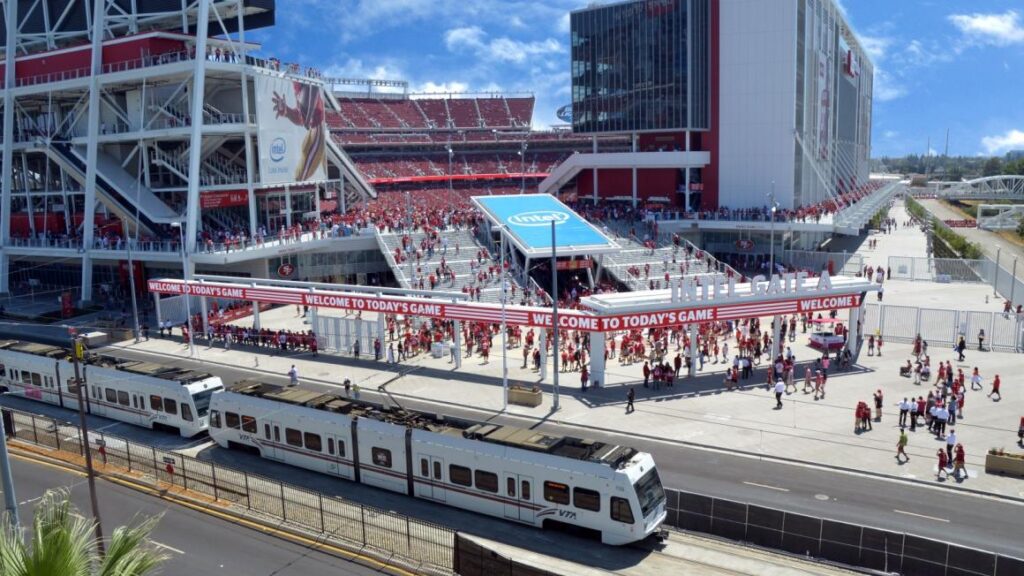
In Santa Clara, transit connections are far more diverse and fan friendly. It is served by VTA light rail and by regional commuter rail services ACE and the Capital Corridor. Riders on Caltrain commuter rail, which runs the length of Silicon Valley, connecting San Francisco to San Jose, connect with VTA light rail at Mountain View. (BART, the Bay Area’s workhorse heavy rail system, does not serve Santa Clara.)
With existing infrastructure, agencies such as VTA are increasing their capacities on game days and are encouraging fans to use existing park-and-ride facilities (at no charge). Bay Area agencies are not planning on deploying any special routes or services. The City of Santa Clara is, though, aggressively promoting ride-share, fitting for the home region of Uber and Lyft.
“We do end up deploying more resources for these mega events as compared to our regular 49ers games,” Bajwa said. “It’s about moving more people in a more effective manner. For the Super Bowl, we moved approximately 15,000 people during egress in approximately 90 minutes. We had to add additional resources in order to supplement service — you don’t want people waiting in queue lines for a long time.”
Though attendance at World Cup matches may not differ from those at NFL games, the fans will. The World Cup is expected to draw 1.2 million international visitors, and many more domestic attendees who will travel to games, meaning that many fans may lack the navigational skills of local residents. Officials in the Bay Area are trying to accommodate those visitors.
“Close to the matches, we have a lot of interactive wayfinding via floor decals and banners that’ll go up highlighting transit,” Bajwa said.
“The only thing that’s going to be different is that for these World Cup matches, there tend to be fan marches,” Butts said. “You can end up with 1,000 to 5,000 fans that want to march and show support for their teams. We won’t know until June 12th if those manifest themselves, but we do have plans and staging areas should they happen.”
Given the enthusiasm of many soccer fans, they might make the BTS Army look like a scout troop.
Metro is also a major sponsor of watch parties and “activations” around the region, including in downtown Inglewood. VTA is similarly encouraging fans to take public transit to the region’s official watch parties.
Whether agencies will come out winners from the World Cup remains to be seen. Research indicates that many cities that host mega-events, including World Cup matches, are burdened with costs that FIFA or equivalent organizations do not reimburse. The federal government issued grants to assist regions with World Cup transportation; Los Angeles received $9.8 million, and the Bay Area received $8.8 million.
Whether those grants cover costs remains to be seen.
“We’ve never done this before, so it’s a little hard to plan on specific numbers,” Bajwa said. “But the bottom line for VTA is that we provide the service that’s needed to get people to the stadium — we kind of figure out the costs and things like that as we go.”
Josh Stephens is a freelance writer based in Los Angeles.