

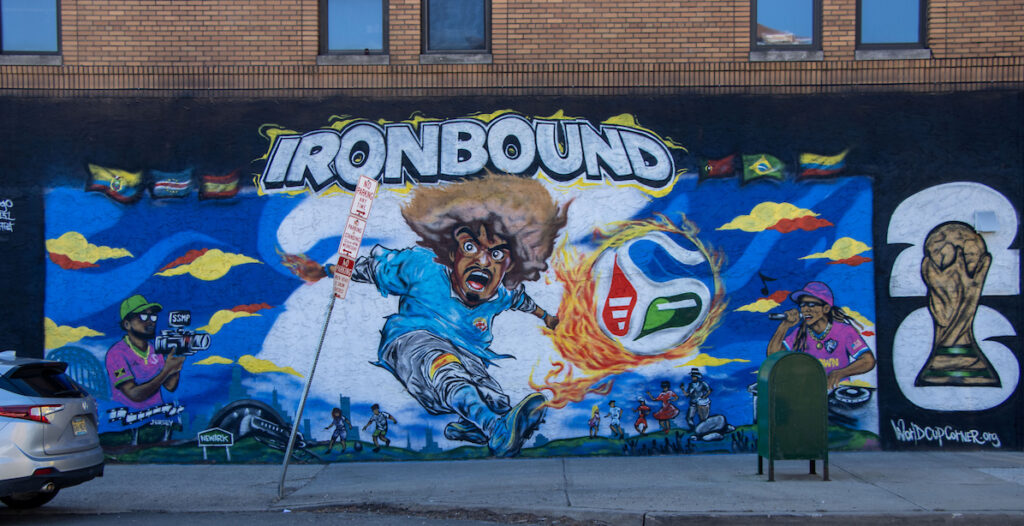
WHEN IRA KHERKI Kaifa first learned that the FIFA 2026 World Cup would be coming to the New York City Metropolitan area, he knew he had to act. “This is a once-in-a-generation thing coming to our backyard. We have to be the first to do something.”
After it was announced that the five-week soccer tournament would conclude with the final played at MetLife Stadium in East Rutherford, New Jersey, Kaifa, an artist, told a gathering of local small businesses and arts groups in the Ironbound neighborhood of Newark, that he planned to do art activations, musical performances and other activities. “We have a great opportunity, especially if we start planning now,” he said. That was two years ago.
World Cup Corner
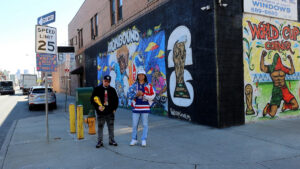
Fast forward to 2025 and Kaifa, along with two other artists, turned the graffiti-ridden walls of a dilapidated building into a giant mural celebrating the World Cup. As they started to plan events on weekends leading up to this summer’s global soccer tournament, Kaifa said they decided to call it World Cup Corner. The site is recognized on Google Maps as a cultural location. For Kaifa, it only made sense to locate the mural in the Ironbound, a diverse neighborhood that includes many residents with ties to countries that had already qualified for the tournament, including Brazil, Colombia, Ecuador, Portugal, and Spain.
While the World Cup will be played in 80,000-seat stadiums across 16 cities in North America, plans are being made to bring communities together on a smaller scale and boost the local economy in cities and towns. Placemaking opportunities abound, with more than 100 matches scheduled, and certainly events aren’t limited to the 16 host cities.
Kaifa was not around the last time the U.S. hosted the World Cup in 1994 but understands the opportunity it represents. “I know the power of being the first to do something,” said Kaifa, who also is a pioneer in the Jersey club music scene. Thirty-two years ago, New Jersey played host to seven matches, including a semifinal, at the former Giants Stadium site while the Rose Bowl in Pasadena, California, got the final (where Brazil defeated Italy, 3-2, on penalty kicks).
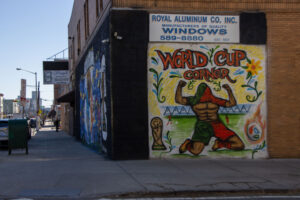 The mural’s location at Market and Somme streets is across the Passaic River from Sports Illustrated Stadium, home of Major League Soccer’s New York Red Bulls. (The Harrison, New Jersey facility will host the NYNJ World Cup 26 Jersey Fan Hub.) It is visible from three different streets. Months ahead of the World Cup, and when events are not taking place, the site has become an “Instagrammable location,” drawing people.
Even before the mural was completed, it was drawing curiosity seekers and others. “That’s when I started to realize the power of the sport of soccer and the fever that it brings to a community,” said Kaifa, whose artist name is Unicorn151. “World Cup Corner at least gave us an anchor, to say we’re the first, we can position ourselves as coordinators for World Cup tourism.”
Kaifa collaborated with muralist Jose Vega, who’s artist name is Torch Fuego, and graphic designer Francisco Pereira, a.k.a., Knod The Artist. The trio completed the project in about three weeks and unveiled it in November. Weekly events like art activations and musical performances kicked off in March.
World Cup Corner has received exposure via several websites that post international murals, and so it’s drawn interest from international artists, performers, and musicians to be part of the art activations, according to Kaifa. “In the end, this would set up as a legacy in Newark, and as artists,” he said.
In nearby Elizabeth, officials started planning even before the 2022 World Cup ended. The marketing team at the Greater Elizabeth Chamber of Commerce geofenced the arena in Qatar where the final was played, and local airport, with a welcome message for the 2026 World Cup, President and CEO Jennifer Costa said. They retained the mobile data and sent a series of text messages.
The Chamber had plenty of practice in recent years, with viewing parties and celebrations during FIFA Club World Cup 2025 and the 2024 Copa America, both of which were also played at MetLife Stadium.
Elizabeth’s Morris Avenue Latin District played host to thousands of people of all ages for the Copa final between Argentina and Colombia, a multi-generational effort including Elizabeth youth soccer organizations, local restaurants, and Colombian dancers, and music. The Chamber has employed promotional videos, splashed across its website and Instagram. The city is home to more than 50 nationalities across 12 neighborhoods.
With more than 2,600 room nights at any time across eight hotels in the Elizabeth market, Costa said anyone who checks in to local hotels during the tournament will receive a key card jacket with a QR code that takes users to their World Cup tourism web page.
The Chamber is also mobilizing for another massive celebration this summer. It’s playing up the city’s notoriety as one of the earliest settlements in the U.S. Elizabeth will host key aspects of the America 250 celebrations along its waterfront.
“With identifying the influx of people coming, we’ve mobilized how to think holistically about the community and multi-generationally,” Costa said.
Events to capitalize on World Cup fever can go far beyond the 16 cities that will host matches. [See Sidebar: How to Transform Public Spaces for the World Cup]
There’s a Festival for That
Decatur, Georgia, is less than 10 miles from where eight World Cup matches, including a semifinal, will be played in downtown Atlanta and a FIFA Fan FestivalTM will take place at Centennial Olympic Park.
 Despite its proximity to Atlanta, Decatur plans WatchFest ’26. The 34-day festival will feature World Cup watch parties as well as concerts by local and regional performers, headlined by Big Boi, the Indigo Girls, and The War and Treaty. It helps to have a couple of big selling points. Downtown Atlanta is just a 25-minute ride via the Metropolitan Atlanta Rapid Transit Authority (MARTA). On top of that, literally, is Decatur Square, a 4.7-square-mile center often cited as a great, walkable neighborhood filled with shops and restaurants.
The goal is to complement events in Atlanta and do something culturally significant with a local angle, according to City Manager Andrea Arnold. “To open with Big Boi and close with the Indigo Girls, it doesn’t get any more Decatur than that,” she said. “That’s how we’re celebrating: Go to Fan Fest, and when you’ve had enough, come out on the train, have a beer at a local pub and watch a show and a match. It should be a different, cool vibe nonetheless,” Arnold said, and a counterbalance to the fun in Atlanta.
“We have history in our favor,” said Arnold, recalling that Atlanta and Decatur served as the main hubs for the 1996 Summer Olympics in Atlanta. “We talk about Decatur before and after the Olympics.”
The city is no stranger to special events. Arnold points to a T-shirt created by a local blogger that sums it up: “Decatur: There’s a festival for that.” The Decatur Arts Alliance is behind the Decatur Arts Festival, Oakhurst Porchfest, and Decatur Wine Festival, as well as abundant public art. There’s also the Decatur Craft Beer Festival, the Decatur Book Festival, and Pan-African festival, among others.
Decatur started planning for the World Cup almost two years ago, according to Arnold. The City Commission appointed a volunteer committee and set them off to plan for the event. The city also hired a consultant with extensive experience in sports events planning, including the Super Bowl and other World Cup events, with established relationships.
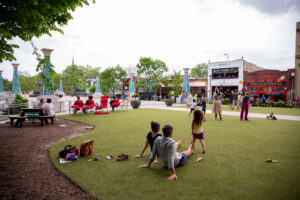 Planning for an $8.5-million renovation of Decatur Square began several years ago, prioritized through a community planning process. Construction on “Decatur Town Center 2.0” began last summer and will be completed ahead of the World Cup.
An old gazebo that hosted small bands is being replaced by a state-of-the-art performance stage. Another area of the square that had been dormant will be “activated” with a children’s play area, Arnold said. In addition, public restrooms will be added and turf replaced. The three-day Amplify Music Festival will break in the new stage the weekend before the World Cup events kickoff on June 11.
Businesses endure these projects and while they know it’s for good, it’s something they must persevere, Arnold said. “What better way to say thank you than to throw this big party for 34 days,” she said.
An economic impact report released in March models scenarios of the city welcoming 3,500 to 10,000 visitors a day for the events, estimating total spending of $62 million to $143 million. On an average day, Arnold said she expects 3,000 to 4,000 people, which would be typical of a Decatur festival, while the high end of 10,000 is more likely for concert days. For reference, Decatur has about 25,000 residents.
The lion’s share of the $1.5 million cost will be staff time and public safety overtime (police, fire and public works), along with renting fencing, portable toilets, tents, water stations, and the like, according to Arnold. That cost will be shared through a partnership between the city, Decatur Downtown Development Authority, and Decatur Tourism Bureau.
Pedestrian improvements in a walkable town
While Decatur has been consistently making improvements to downtown corridors with sidewalks, bike lanes, and general repairs, Arnold said they also have identified areas to improve the pedestrian experience.

A WatchFest logo has been incorporated into striping and signal timing at the corner of Sycamore and Church streets, which will feature a three-direction “pedestrian scramble.” The initiative stops all vehicle traffic to allow pedestrians to cross in any direction at the same time. “It’s a very visible way to call attention to WatchFest,” Arnold said.
There’s also a “quick build” project on two streets that go directly into downtown. One block each of Claremont Avenue and Church Street are getting fresh paint to narrow the roadway and implement bike lanes to make it more pedestrian friendly. The pilot project will be in effect during the World Cup and may become permanent, Arnold said.
The biggest challenge has been the need for coordination and cooperation among different agencies and jurisdictions, whether it’s the transit agency, utility companies, county, city or state officials. “That can’t be an afterthought,” Arnold said. It’s not the time to start developing those relationships – “you can’t wait for an emergency to develop relationships, you have to have those relationships in place,” she said. “It just makes it easier when these are your partners that you’ve had in place for years.”
Amidst all the planning, Arnold’s first thought is safety. “Every decision is through this lens, what’s the impact on safety,” she said. “I want to think about it so when you’re here with friends and family, you’re able to take it for granted, walk away, and just think about how enjoyable that was.”
Mark Hrywna is editor of InTransition magazine.