

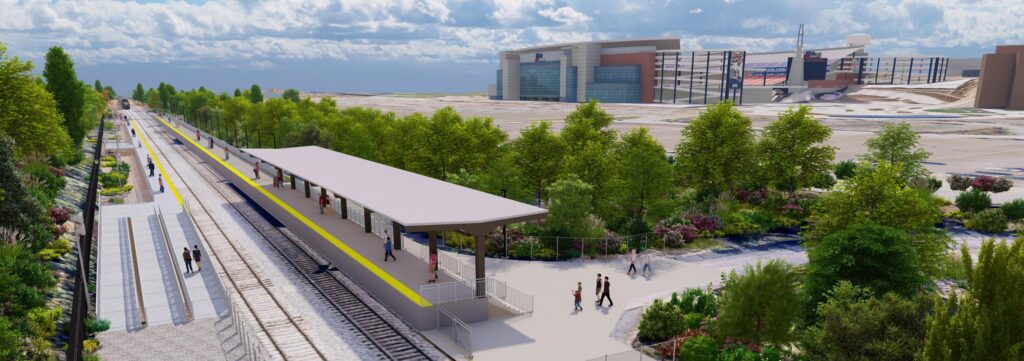
KANSAS CITY ADDED a fleet of 200 buses to accommodate an expected crush of soccer fans. In Massachusetts, construction of a permanent train platform at Foxborough Station was fast-tracked in time for the World Cup matches. Transit agencies in the 11 U.S. cities hosting World Cup matches have been planning for years with some improvements expected to remain as a legacy after the world’s most popular sporting event concludes.
World Cup sites have similar strategies when it comes to transit, according to Philip Plotch, Ph.D., AICP, principal researcher and senior fellow at the Eno Center for Transportation in Washington, D.C. They will tap into some federal funds, undertake regional coordination, integrate their security teams with federal agencies, establish new temporary transit routes, set up park-and-ride facilities, coordinate with FIFA, increase bus and rail services, deploy customer information teams to prominent locations, and limit parking.
“Predicting demand, whether it’s how many World Cup hats you’re going to sell or how many riders you’re going to attract, is a science — but it also involves lots of guess work,” said Plotch, who worked on the transportation planning for New York City’s bid for the 2012 Summer Olympics that ultimately was awarded to London.
The Federal Transit Administration (FTA) allocated more than $100 million to 11 host U.S. cities:
STADIUM / HOST CITY |
APPORTIONMENT |
| MetLife Stadium — East Rutherford, NJ/New York (8) | $10,438,681 |
| AT&T Stadium — Arlington/Dallas, TX (9) | $10,033,037 |
| SoFi Stadium — Inglewood/Los Angeles, CA (8) | $9,603,284 |
| Mercedes-Benz Stadium – Atlanta, GA (8) | $9,391,018 |
| NRG Stadium – Houston, TX (7) | $9,092,387 |
| Levi’s Stadium — Santa Clara/San Francisco, CA (6) | $8,807,888 |
| Hard Rock Stadium — Miami, FL (7) | $8,697,430 |
| Gillette Stadium — Foxborough/Boston, MA (7) | $8,671,598 |
| Arrowhead Stadium – Kansas City, MO (6) | $8,632,123 |
| Lincoln Financial Field – Philadelphia, PA (6) | $8,474,327 |
| Lumen Field – Seattle, WA (6) | $8,408,439 |
Seventy percent of the funding was based on stadium capacity with 30 percent based on how many matches a facility would host. Funding supports matches or public events, including planning, operating, and capital expenses, with a goal to increase service for the World Cup.
Even with those federal funds and state grants, officials at NJ TRANSIT estimate up to $48 million in costs to transport soccer fans to MetLife Stadium (renamed NYNJ Stadium for the tournament to avoid conflicts with FIFA sponsorships). The statewide transit agency for New Jersey announced a transportation plan for the World Cup in April that includes a $150 train fare from Penn Station in Midtown Manhattan to the stadium, a journey that normally costs about $16. Shuttle buses from Manhattan will run $80. Thanks to sponsors and other efforts, NJ TRANSIT recently announced that train fare will be reduced to $105.
It’s not just spectators getting to the games who will be impacted by the crush of fans. People going about their day in the vicinity of the stadiums are expected to notice too and not just commuters on trains, buses, and highways. The Office of Freight Planning at the New Jersey Department of Transportation (NJDOT) issued guidance for World Cup events at MetLife Stadium throughout June and July. Conditions “should not be viewed as routine congestion,” according to the guidance, with match-day traffic expected to “resemble the impacts typically associated with major emergency situations or severe weather events, with limited opportunities to recover once congestion develops.”
Transit Agencies Make Improvements Beyond World Cup
If all the World Cup games were to be played in the same city, Plotch said there probably would be more permanent transit infrastructure built. The World Cup is being played in 16 cities across three countries, and no city hosts more than nine matches. By comparison, the 2028 Summer Olympics in Los Angeles will have more than 300 events and that is spurring L.A. Metro to complete 28 projects before the Opening Ceremonies, Plotch said.
NJDOT invested more than $62 million in improvements in and around the East Rutherford, New Jersey complex, much of it in technology like Intelligent Transportation Systems (ITS) that will be used for future events, according to Christopher Feinthel, Assistant Director of Operations. About $24 million went toward repaving roads and another $16 million for drainage improvements to ensure bus mobility is not impacted by storms, in addition, to upgrades to improve aesthetics along World Cup routes.
Investments along Route 120/Paterson Plank Road include a hard shoulder to support a NJ TRANSIT bus rapid transit lane that can be used for future large-scale events. There also will be dedicated lanes with special routes for more than 3,800 FIFA fleet vehicles and VIP guests from designated pick-up locations in New York City to the Meadowlands.
Improvements to Foxboro Station adjacent to “Boston Stadium,” renamed temporarily for the World Cup, began last August, fast-tracked in anticipation of the tournament this June. What once was a single platform will feature a new, permanent, full-height, accessible platform at Foxboro with all standard station amenities, including canopies, benches, wayfinding, lighting, security cameras, and communications equipment, to accommodate soccer fans heading to and from World Cup matches.
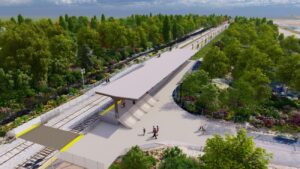
The new platform will enhance operational flexibility and passenger capacity during large-scale events, Lisa Battiston, Deputy Press Secretary for the Massachusetts Bay Transportation Authority (MBTA), said in part via email. Work will stop during the World Cup matches, although the upgrades will be substantially complete, with final punch-list items and landscaping taking place over the summer, she said.
The $35-million project was prioritized within the MBTA’s proposed FY 2027-2031 Capital Investment Plan (CIP), which is funded by federal, state, and MBTA sources, and third-party reimbursements. But the MBTA is also banking on more than farebox revenue and federal funds to cover the cost of service. The 22-mile, one-hour trip from Boston to Foxborough’s stadium typically runs about $17 for commuters but for World Cup matches, it will require an $80 fare.
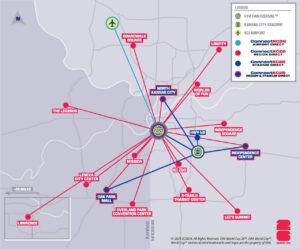
Kansas City expects 650,000 visitors to World Cup matches and the FIFA Fan Festival. In March, KC2026 signed a lease for 200 buses to be used during the World Cup, touting Kansas City, Missouri, as the first of the 16 host cities to announce it had procured buses for the tournament.
Funding comes from a mix of public and private sources, including regional partnerships and event-related investments, according to a KC2026 spokesperson, although he did not have a specific number to share.
“Expanded bus service is part of KC2026’s fully integrated transportation plan that will include a convenient park-and-ride system, the Kansas City Streetcar and expanded ways to bike and walk,” according to a press release. The Host Committee released a regional transit video showing off how people will get around the region during the World Cup. After two years of construction, KC Streetcar will complete a 0.7-mile extension from the riverfront to downtown in time for the World Cup.
Amtrak is getting into the act too, adding railcars on the Missouri River Runner service between St. Louis and Kansas City to provide more capacity across 10 stops in Missouri during the World Cup. The additional cars, transferred from Illinois and Michigan, will be added to both daily 283-mile roundtrips, adding 25 percent capacity to each train.
“Planning for mega events is fascinating. And, of course, a bit stressful,” Eno Center’s Plotch said. “For transit agencies, it’s a time to attract new riders and build public support for your services. At the same time, if you mess up, the whole world will know about it.”
– Mark Hrywna