

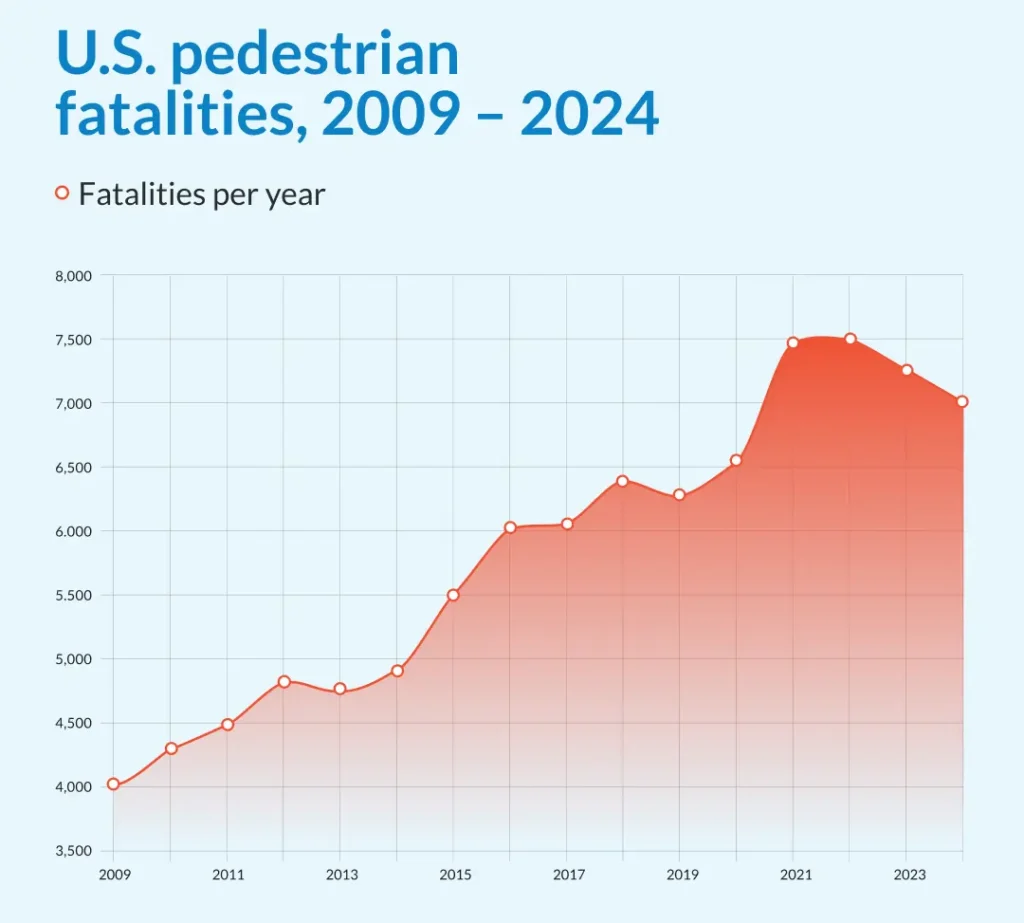
If pedestrian deaths in the U.S. continued to decrease as they have in the past two years, it would still take another 16 years to reach levels last seen in 2009.
Smart Growth America’s annual report, Dangerous by Design, suggests that the U.S. still has a long way to go to match fatality rates of peer countries. In fact, the report calls for a goal of 8.73 deaths per 100,000 people as the new minimum safety standard for what the U.S. considers “success” in improving roadway safety. That would be a 25-percent reduction of the current U.S. rate of 11.7.
While pedestrian deaths have decreased about 6 percent from 2022 to 2024, they increased by 72 percent between 2009 and 2024. The average annual pedestrian fatality rate per 100,000 residents among the 20 deadliest metros has all but doubled from 1.96 in 2009 to 3.93 in 2026.
Only 18 of the 101 metro areas examined saw decreases in the pedestrian fatality rate. Six of the top 20 deadliest metros are in Florida and five are in California. Almost all the top 20 deadliest metros are in the southern parts of the U.S., and with few exceptions, most of deadliest states are also in the South. Delaware was the only state in the top 20 to see an improvement.
The complete report can be found here.