


In certain corridors, projects that take advantage of advanced Artificial Intelligence (AI) machine learning algorithms and new data sources from connected vehicles, roadside units, and vehicle-to-everything (V2X) technology make intersections even more efficient. That’s great, if you’re in a car; you just sail on through on the way to your destination. But that same intersection can be a harrowing, Frogger-like experience for pedestrians contending with permissive lefts, right turns on red, lightning-quick walk signals, and other hazards.
How is modern AI like computer vision, advanced machine learning algorithms, and large language models (LLMs) helping to make such intersections safer for those not in a vehicle? How is adaptive signal control technology (ASCT) turning all that new data and the algorithms that crunch it to solve safety problems? One expert contends it’s not, at least not yet and not explicitly. But it could. Here’s how.
ASCT and AI-Driven Signals
Traditional traffic signals rely on timing plans built from past counts and updated every few years. Adaptive signal control technology changes that logic.
Legacy systems developed from the 1970s to the turn of the 21st century, such as Sydney Coordinated Adaptive Traffic System (SCATS) and Split Cycle Offset Optimization Technique (SCOOT) collect live data from inductive loop detectors, then adjust cycle length, green splits, and offsets on the fly to adapt to demand. These inductive loops are buried in the road and count disruptions from passing cars in the electromagnetic fields they generate.
Evaluations in Virginia and elsewhere have found that adaptive signal control can significantly reduce average delay, number of stops, and travel time for motor vehicles compared with fixed-time control. A 2021 Federal Highway Administration (FHWA) study went further, suggesting adaptive systems can contribute to fewer crashes at some urban intersections, although results vary by context and design.
The “AI” label typically enters in two places:
- Pattern recognition and prediction: Machine learning models mine historical and real-time data from roadside units and connected vehicles to flag unusual congestion, forecast near-term conditions, or reconstruct vehicle trajectories along arterials.
- Decision support for operators: Analytics tools suggest timing changes or maintenance actions and prioritize corridors needing attention, rather than replacing human judgment outright.
Across these deployments, key performance indicators are standardized and known Automated Traffic Signal Performance Measures (ATSPM). According to the FHWA, ATSPM is a suite of almost two dozen metrics. The nature of the project determines which are relevant. ATPSMs include:
- Average delay
- Percent arriving on green
- Travel time
- Throughput
- Volume to capacity
Nearly all ATSPM metrics are measured in the context of cars. The only one that isn’t is conflicting pedestrian volume. Safety is typically assessed outside the real-time control loop through periodic crash analysis, not as a live signal that can change how the system behaves minute by minute.
Optimizing a Car-first System
This is where the philosophical problem comes in.
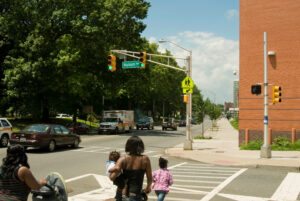
For decades, traffic engineering guidance has centered on level of service (LOS) and delay, metrics that were explicitly created to describe the quality of motor vehicle operations at intersections and along roadways. In many jurisdictions, minimum LOS thresholds for drivers still trigger capacity projects or signal changes, while delay for people walking, biking, or riding on mass transit is rarely measured to the same standard.
Wesley E. Marshall, PhD, a civil engineering professor at the University of Colorado Denver whose research focuses on road safety and equity, has directed much of his research into interrogating those assumptions. “Traffic lights…are optimized to reduce delay, and delay in that sense is driver car delay,” he says. “It’s usually not pedestrian delay or transit delay. They’re not focused on people movement. They’re focused on car movement.”
This car-first philosophy extends to matters of safety. Take roundabouts, for example. Research suggests they can reduce fatal crashes by up to 70 percent, says Marshall, “But when deciding between a roundabout and a traffic signal, it’s usually not about safety,” he says, but rather metrics like throughput and cost.
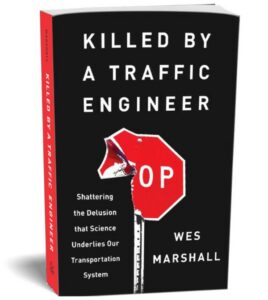 The same pattern shows up when congestion is treated as a proxy for safety. According to Marshall, conventional wisdom states that optimizing for congestion has knock-on safety effects, but there’s really no strong evidence for that. This is the premise of his 2024 book, Killed By a Traffic Engineer: Shattering the Delusion that Science Underlies Our Transportation System.
Yes, adaptive signals that smooth traffic can lower the risk of some crash types, particularly rear-end collisions related to stop-and-go waves. But, says Marshall, “Safety was never embedded within those protocols like we were taught it was.”
Vision Zero and the broader Safe System approach invert that priority hierarchy. They start from the premise that deaths and serious injuries are unacceptable and that transportation systems should be designed and operated to accommodate human error and vulnerability, even at the cost of more delay for drivers.
AI and adaptive control can support that shift. But without a change in what agencies choose to measure and reward, the algorithms simply encode the old values with greater finesse.
Inside New Jersey’s Arterial Management Center
 New Jersey’s Arterial Management Center (AMC) offers a concrete example of both the promise and the limits of this technology.
“The AMC has modernized traffic operation using adaptive signal control, real-time data fusion, and AI-powered predictive analytics,” says New Jersey Department of Transportation (NJDOT) spokesperson Steve Schapiro.
Launched in Trenton, the AMC serves as a centralized hub for operating and monitoring state-owned signals on key corridors. “The AMC has a suite of dashboards to monitor traffic signal performance and provide decision-support to traffic engineering staff who modify traffic signal timing parameters,” Schapiro says.
According to a 2025 case study from the NJDOT, the AMC:
- Manages widespread deployment of SCATS-based adaptive signal control on state arterials.
- Fuses data from multiple sources, including video, radar, and GPS-based vehicle probe data analytics.
- Applies AI-driven analytics to forecast congestion, prioritize maintenance, and support proactive operational decisions.
Reported results along several corridors include travel delay reductions in the 10 percent to 30 percent range and fewer congestion-related crashes, alongside reductions in unplanned signal maintenance due to better monitoring of equipment health.
 Parallel research funded by NJDOT on Real-Time Signal Performance Measurement (RT-SPM) and ATSPM created a standardized framework for turning those raw controller events into performance dashboards inside the AMC. The metrics include arrivals on green, cycle failures, and other indicators that help operators see almost in real time how well each signal and corridor is moving traffic.
Safety is a core part of this picture. NJDOT documents explicitly connect the AMC and RT-SPM work to both mobility and safety goals, and the case study highlights potential crash reductions as one of the benefits of more reliable, less congested operations.
“Pedestrian safety is enhanced by evaluating crossing delays and behaviors, informing strategies that balance pedestrian access with vehicle flow,” Schapiro says. “We have deployed leading pedestrian intervals, passive pedestrian detection in crosswalks, and red clearance extension technologies at locations where it was determined to be beneficial.”
But day-to-day optimization still mostly revolves around moving cars. The AMC’s five most important key performance indicators, according to Schapiro, are:
- Travel time reliability
- Cost of delay
- Congested hours
- Pedestrian delay
- Degree of saturation
Says Schapiro: “Our main prioritization rule for corridor selection is traffic congestion.”
The AMC has the data, the analytics, and the centralized control to act on those conflicts in something close to real time. Whether it does so consistently depends on how safety is weighted alongside efficiency in the objectives that guide operators and algorithms.
How AI Can Support Safety
The AMC shows that AI-enabled operations centers can absolutely make major corridors run more smoothly and predictably. They can even contribute to safety, particularly by reducing congestion-related crash types and flagging performance problems before they become failures.
What they cannot do on their own is decide that a bus full of riders, or a person in a crosswalk, is more important than shaving a few seconds off a driver’s trip.
Marshall notes an intersection on the street right outside his office at CU Denver. “There’s a LIDAR sensor out there collecting all sorts of data,” he says. Nevertheless, the intersection is still dangerous for pedestrians trying to cross while cars are turning left.
“We could use this data to fix it, but the city isn’t willing to even give it a try,” says Marshall.
The Future Is Human
For all its seeming intelligence, AI is essentially math. A machine learning algorithm can’t try to cross six lanes of traffic on foot, and an LLM can’t ride in the bike lane on a too-narrow road and hope for the best.
 Marshall reminds his students of this need for human experience and judgement with “Empathy Week.” His classes go out into the city of Denver, donning glasses that mimic vision impairment, navigating the streets in wheelchairs, and understanding the challenges in store for pedestrians, cyclists, and people with certain disabilities. He says the students get a very stark idea of how much trouble a simple uncut curb can be and how perilous it is crossing arterial roadways.
“Sometimes you need to get out from behind the computer monitor and go experience it for yourself, not just as a driver but as a pedestrian or even someone with limited mobility,” Marshall said.
All the new real-time data and advanced algorithms can’t help make roads safer unless they’re turned to that purpose, and AI is no substitute for an experienced, empathetic engineer or planner. The AMC knows it.
“In the AMC, AI is used to collect and analyze data and make predictions for certain outcomes,” says Schapiro. “Human traffic operators and traffic engineers ultimately make the decisions and carry out actions.”
Patrick Sullivan is a freelance writer based in New Jersey.