

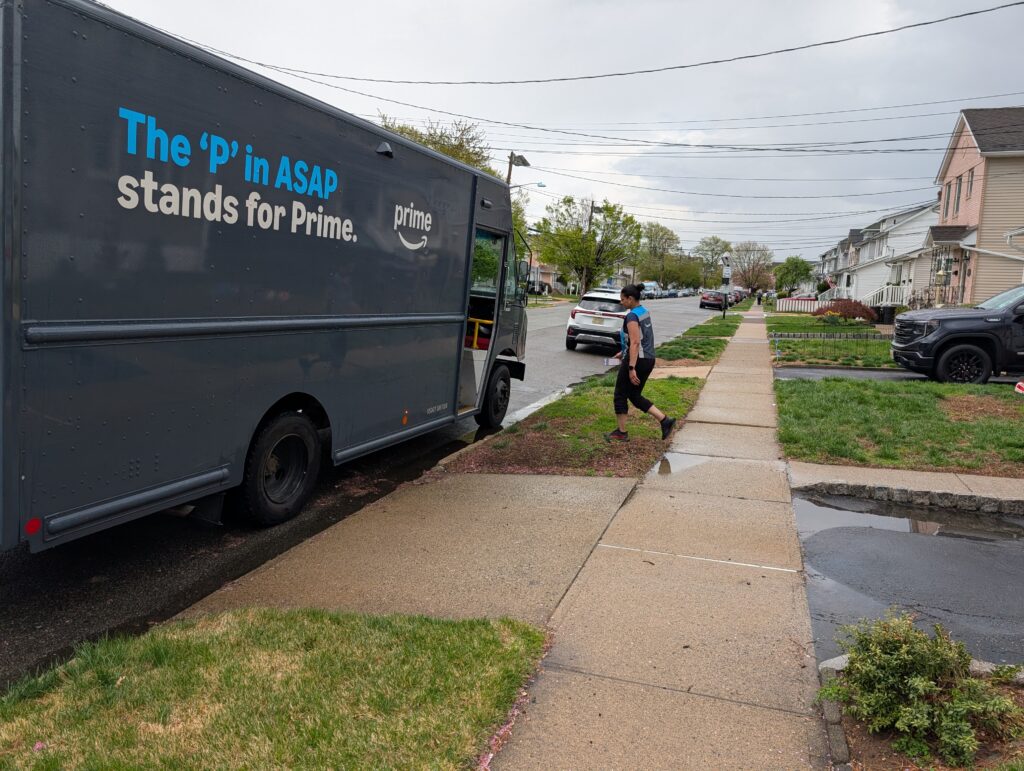
WAIT FOR AN hour or so on any suburban street (mid- to -late afternoon seems the best time) and they will arrive like clockwork – vans of various shapes and sizes delivering packages. Mostly they are the familiar navy blue Amazon vans, many with slogans on the side touting their speed, such as “Is now a good time?” or “The P in ASAP stands for Prime.”
Their ubiquity is an indication of the extraordinary growth of e-commerce in recent years. Shopping online has become integral to modern life, dramatically increasing goods traveling over the transportation network, from major highways to local streets. However, the recent rise in fuel prices added a note of caution about the momentum. In March, the United States Postal Service (USPS) announced an 8-percent surcharge on packages and other major carriers are adding their own.
Yet the clock cannot be turned back. During the pandemic, e-commerce took a giant leap – increasing 43 percent from 2019 to 2020. In 2024, consumers were receiving an average of 66 packages per year, or more than one per week, according to Capital One Research.
And the packages are coming faster than ever. In just a day or less, you can have almost any product delivered to your doorstep (or foyer or package locker). In many areas, Amazon Prime members can select from 90,000 products that can be delivered within three hours for a $4.99 fee.
While 80 percent of purchases are still made in person – particularly groceries, personal care items and some clothing – consumers avidly seek out online deals. Shopify finds 54 percent of customers engage in “showrooming,” browsing in store and buying online. We may be willing to shoulder a bit higher delivery cost to keep the packages coming.
But over the long term, is it sustainable? What are the impacts on communities and the environment? Should shoppers continue to browse and order without a thought?
Hidden Players
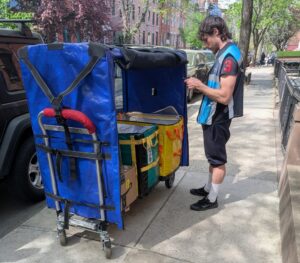
To most, e-commerce remains largely hidden in plain sight. You may notice delivery vans coming and going or workers wheeling unwieldy collections of packages down the street. If you use an app to order food or groceries, the delivery worker arrives with their (virtual) hand out for a tip.
 Behind the scenes, however, is a roiling e-commerce marketplace with numerous players, in ever shifting partnerships and combinations. “There are complex options” for companies seeking to get a product to consumers,” says Jonah Bliss, who writes the Curbivore Substack e-newsletter, which covers developments in delivery logistics, city planning, and automated transportation. “If we spent 30 minutes discussing them all, we wouldn’t even finish.”
This includes third-party logistics or 3PL firms, which have sprung up — some funded by venture capital – to help retail companies deliver e-commerce orders. Getting goods to far-flung locations across the country often requires sophisticated planning, coordination and execution beyond the capabilities or resources of most companies. Some chain stores and online-only brands have built their business models around farming out these activities. 3PLs focus particularly on the crucial “last mile” delivery to homes, which accounts for 50 percent or more of transportation costs.
Competition
The retail colossus Amazon (37.6 percent e-commerce market share) virtually invented the e-commerce marketplace and drives most trends. It mostly relies on contract carriers in its Direct Partners program for its deliveries (in Amazon-branded vehicles). But it also contracts work to 3PLs where that makes the most sense.
Its largest contract carrier is the USPS, which in recent years has handled 15 percent of deliveries (and even more in rural areas). Last year Amazon sought to drastically curtail that role in favor of its own delivery network, threatening to pitch USPS further into debt. This spring negotiations settled on a 20-percent reduction in deliveries by the Postal Service.
This is part of Amazon’s relentless efforts to cut costs and improve efficiency in competition for consumer dollars with its biggest rival Walmart, the nation’s largest retailer with 6.7 percent e-commerce market share. Lesser rivals include Target, The Home Depot and Costco. They are all exploring and testing cutting-edge delivery technology such as AI, delivery drones in suburban and rural areas, and automated sidewalk delivery robots on city streets.
OneRail, a 3PL, recently partnered with FedEx to compete with Amazon using AI systems to route goods efficiently to consumers, using its network of 1,000 carriers and existing warehouses, fulfillment centers and retail locations.

In what has become something of the Wild West of the marketplace, the e-commerce companies increasingly use gig workers to rein in labor costs. Anyone with a car and cellphone can start making deliveries for these app-based companies, but the work is low paying and often grueling (see sidebar, “E-commerce and Gig Work”).
Despite the many players involved and rapid growth of e-commerce, it’s an open question whether the pace of growth and the trend toward superfast deliveries can be maintained. Bliss notes that many e-commerce companies are speculatively financed, taking a loss and “hoping that they reach some volume and technological maturity that makes it work in the long run.”
An extended period of high fuel costs could present challenges to the more fragile start-ups. Still, companies in recent years have gained experience and put in place extensive facilities to continue growth — though perhaps with more costs passed on to consumers.
New players will also enter the picture. “There’s so much opportunity, so much money to be made, people are going to keep cropping up with new ideas,” says Bliss.
Community Impacts
Many communities across the country are confronting a variety of impacts from the rising tide of e-commerce. The nation’s dense major cities, home to about 20 percent of the U.S. population, are most impacted and taking steps to combat mounting traffic congestion and worsening air quality, including unhealthy concentrations of particulate matter from trucks.
New York City has rolled out a variety of programs and regulations, including “microhub” zones where goods are transferred from trucks to e-bikes, handcarts, and small electric vans; shared-use package lockers on sidewalks; designated loading zones on residential streets; incentives for overnight deliveries in commercial areas; and more.
But most of the U.S. population resides in suburban or rural areas that were designed to facilitate auto access and auto-oriented lifestyles, that can accommodate the influx of delivery vehicles. In some ways, says Bliss, e-commerce is “making more efficient use of the sunk costs of decades ago in massive parking lots, lots of wide roads and plenty of asphalt.”
In doing so it may be lessening the harm of suburban sprawl. “There are very different impacts on roads and the environment if every delivery truck is replacing 10 auto trips in the suburbs” compared to replacing the walking or transit shopping trips common in major cities, says Sandra Rothbard, transportation consultant and researcher. She notes that research is ongoing to assess the extent of this replacement and the sustainability of e-commerce.
One complicating factor is that online shopping has stimulated impulse buying and overall consumption levels — given the immense array of goods on offer. Generating still more vehicle trips are policies for easy returns. In 2026, almost a quarter of online orders were returned, according to Capital One Research.
Though e-commerce in the suburbs isn’t posing the immediate environmental harm seen in cities, suburban residents would still like it to be more eco-friendly. In 2024, the logistics company Descartes found 57 percent of people it surveyed were “quite or very” interested in “green” home-delivery services. “The last thing we need is a giant SUV driving a burrito around,” Bliss said.
In response – and with an eye on vehicle operating costs – many companies are electrifying their fleets. Amazon has deployed 15,000 electric vehicles (EVs) among its approximately 30,000 delivery vehicles and has committed to 100,000 EVs of all kinds by 2030. Uber and Lyft offer subsidized EV rentals and purchase incentives to rideshare drivers, many of whom deliver packages.
But with so many e-commerce players and the increasing reliance on gig workers using their own vehicles, it’s unlikely EVs will comprise a significant share of delivery vehicles. Bliss said companies “are nibbling at the edges” of electrification but may consider it more seriously due to rising fuel costs.
Competing for Curb Space
The e-commerce industry “is changing faster than government can keep up,” according to Rothbard. Governments have had to strengthen standard “light industrial” zoning to better mitigate traffic, noise and other impacts of the steady flow of vehicles from warehouses at all hours.
 Many towns have confronted growing disorder along their main streets and areas with denser housing, including crashes and safety hazards, much of it involving restaurant deliveries. They’ve begun adopting curb management practices similar to major cities, sometimes part of “Complete Streets” initiatives to balance the needs of all road users, including pedestrians, people on bicycles, delivery trucks, buses and automobiles.
Based on an inventory of street capacity and use patterns, towns control available curb space with loading zones, parking rules, bike lanes and other measures.
Some more heavily traveled towns are turning to technology. Hoboken, New Jersey, has a network of video cameras using AI to detect and ticket vehicles violating parking rules. Nearby Fort Lee implemented an app-based reservation and payment system for delivery vehicles accessing “smart” loading zones.
Small Businesses
Towns have been less successful at addressing the continued loss of small businesses along their main streets and commercial corridors, particularly the mom-and-pop shops, once the hallmarks of small-town America. Many of these retailers struggle to compete with online deals and face rising rents and other costs. “While everyone loves the idea of a bustling [main] street … it requires people to actually spend locally,” Bliss said.
Some state and local governments offer loans and other aid for small businesses and enhance roads and public spaces in business districts. But Bliss thinks many communities have yet to fully reckon with e-commerce’s impact and may need to get creative to address vacancies.
Better educating urban planners about “often ignored” freight issues, including how goods movement integrates with communities, is also needed, says Rothbard.
Countervailing Trends
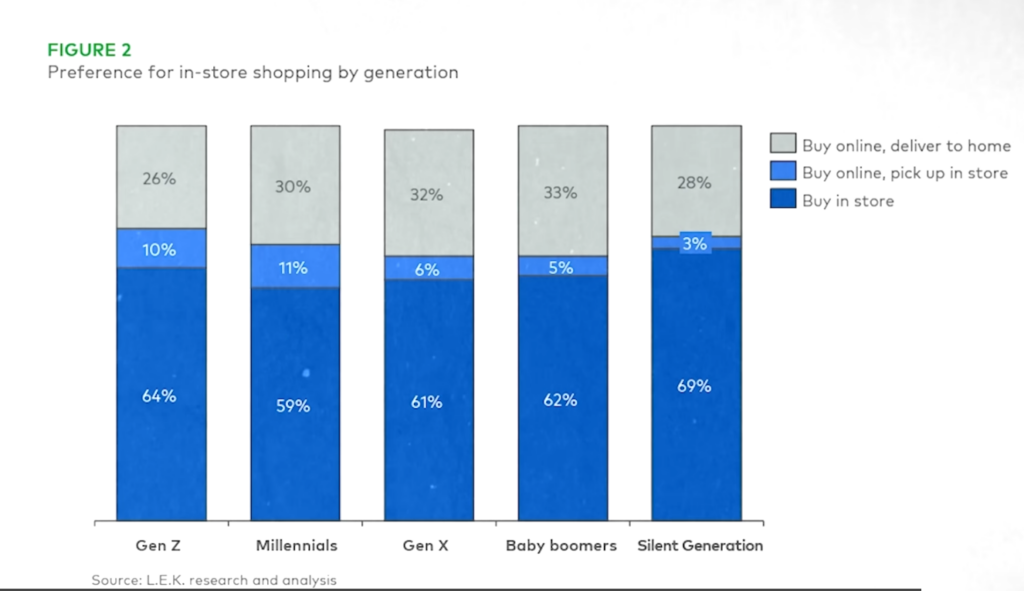 While e-commerce growth was down to 6.9 percent in 2025 from 8.1 percent in 2024, store openings are up 1.4 percent. According to Forbes, Sales have particularly strengthened this year for major department stores after waves of closures and losses. Like other major retailers, they have pursued “omnichannel” strategies – giving customers easy options to purchase in-store or on their websites.
There has also been a surprising shift among customers. Despite growing up as digital natives, 64 percent of Gen Z consumers, born between 1997 and 2012, prefer shopping in-person. They are “spending money in physical stores at a similar rate to their grandparents,” according to CNBC.
It may all add up to a cultural shift trending away from e-commerce. The growth of online shopping after all was not only driven by technological advances providing cheap goods delivered quickly. It required a change in shopping habits and expectations, reinforced strongly during the pandemic as people sat at home ordering online.
Perhaps, led by young people and enlightened local officials, the social and civic aspects of shopping locally can be revived over time. Towns need to do more to “figure out what kind of communities they want to be,” Bliss said.
Mark Solof is a freelance writer based in New Jersey.